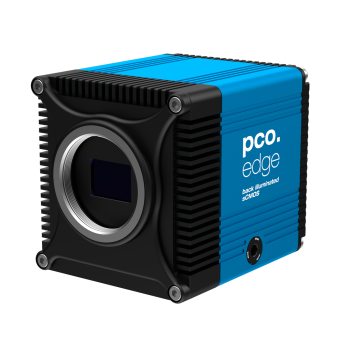
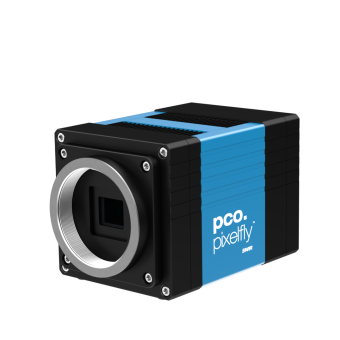
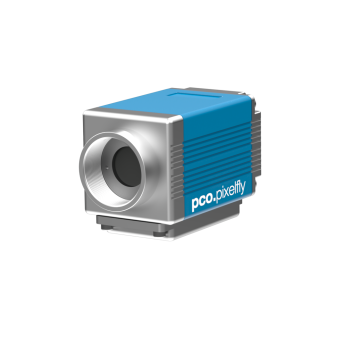
The 5.5 megapixel sCMOS sensor offers a large field of view and high resolution, without compromising read noise or frame rate. The read noise in itself is exceptional, even when compared to the highest performance CCDs. Only slow-scan CCDs are capable of this level of read noise performance. High-resolution, slow-scan CCDs are typically characterized by seconds per frame rather than frames per second (fps). The fact that the sCMOS device can achieve < 2 electrons rms readout noise while reading out 5.5 megapixels at 30 fps renders it truly extraordinary in the market. Furthermore, the sensor is capable of achieving 100 full fps with a readout noise < 3 electrons rms.
By way of comparison, the lowest noise interline CCD, reading out only 1.3 megapixels at ~ 16 fps would do so with ~ 10 electrons readout noise. Greater speed is available through selection of ‘region of interest’ sub-windows, such that the field of view can be traded off to achieve extreme temporal resolution (see the white paper).
The low noise readout is complemented by a high dynamic range of > 16 000 : 1. Usually, for CCDs or emCCDs to reach their highest dynamic range values, there needs to be a significant compromise in readout speed, yet sCMOS can achieve this value while delivering 30 fps. Furthermore, the architecture of sCMOS allows for high dynamic range by offering a large well depth, despite the small pixel size. By way of comparison, a 1.3 megapixel interline with similarly small pixels achieves only ~1800:1 dynamic range at 16 fps.
Further Information can be found on www.scmos.com or is given on this page.
» Publications |
» Where to get the product
Areas of Application
- Live cell microscopy
- Particle Imaging Velocimetry (PIV)
- Single molecule detection
- Super resolution microscopy
- TIRF microscopy / waveguides
- Spinning disk confocal microscopy
- Genome sequencing (2nd and 3rd gen)
- FRET
- FRAP
- Lucky astronomy / imaging
- Adaptive optics
- Solar astronomy
- Fluorescence spectroscopy
- Bio- & Chemi - luminescence
- High content screening
- Photovoltaic inspection
- X-ray tomography
- Ophthalmology
- Flow cytometry
- Biochip reading
- Machine vision
- TV / Broadcasting
- Spectral (hyperspectral) imaging
- Laser Induced Breakdown Spectroscopy (LIBS)
- Night Vision
| | unit | setpoint | scmos |
|---|
 |
| resolution (hor x ver) | pixel | | 2560 x 2160 |
| pixel size (hor x ver) | µm² | | 6.5 x 6.5 |
| peak quantum efficiency | % | | 60 |
| dynamic range | bit | | 16 |
| readout noise | e- rms | @ rolling shutter | 1 .. 2 |
| imaging frequency, frame rate | fps | @ full frame | 100 |
| exposure time | s | | tbd |
| binning horizontal | | | tbd |
| binning vertical | | | tbd |
| optical input | | | Nikon f-mount |
| | | |
| | | |

Comparison of a scientifc grade CCD camera with an interline transfer CCD and a first prototype test application with a sCMOS sensor at weak illumination. Both cameras were simultaneously looking at the same scene with the same lens at same f-stop = 8. The pco.2000 (2048 x 2048 pixel, pixel size 7.4 µm) was operated at 40MHz with 1 readout channel at 1 ms exposure time and cooled to +10 °C. The sCMOS test board (2560 x 2160 pixel, 6.5 µm pixel size) was operated with 1.3 ms exposure time to compensate for pixel size difference and un-cooled.
» Publications |
» Where to get the product
Comparison of field of view
The images show the difference in field of view between the new sCMOS 5.5 MPixel image sensor and a widely used scientific grade CCD 1.3 MPixel image sensor.
Comparison of readout noise levels by image quality
The two columns of images show at different weak illumination levels the image quality of the new sCMOS image sensor with 1.5 e- rms readout noise compared to a widely used scientific grade CCD image sensor with 5 e- rms readout noise.
Comparison of different image sensor types
The images show USAF test chart images and the image quality of three image sensors recorded at low light level. From left to right:
- sCMOS (front illuminated, 1.5 e- rms readout noise)
- scientific grad interline transfer CCD (front illuminated, 5 e- rms readout noise)
- emCCD with gain (back illuminated, < 1 e- rms readout noise)
» Publications |
» Where to get the product